Global daily bulk content reached 2.5 quintillion bytes in 2025. LLMs are a primary cause.
To gain traffic, specialists must publish high-quality content often. This helps you generate a bulk volume of each blog post to build topical authority and grow your organic footprint.
Experts use AI to scan top competitors and their winning strategies. This bulk article generation process lets you generate a blog with high-quality images.
Programmatic tools help you increase traffic. As the way we create content evolves, scheduling pages keeps your blog post portfolio competitive.
This ensures your blog excels by focusing on authority instead of just keywords.
Sustainable bulk SEO focuses on comprehensive niche coverage rather than simple keyword manipulation.
Key Takeaways
- Using human oversight ensures bulk article generation seo maintains high quality and survives core updates.
- High frequency publishing helps marketing specialists establish topical authority and expand their organic search footprint.
- Successful bulk content strategies prioritize information gain over simple keyword targeting to satisfy search intent.
- Manual audits of meta tags and featured images prevent common automation errors like metadata hallucinations.
- Tracking revenue metrics allows business owners to reduce content costs while scaling their organic traffic.
Why Human Oversight Beats Pure AI Automation
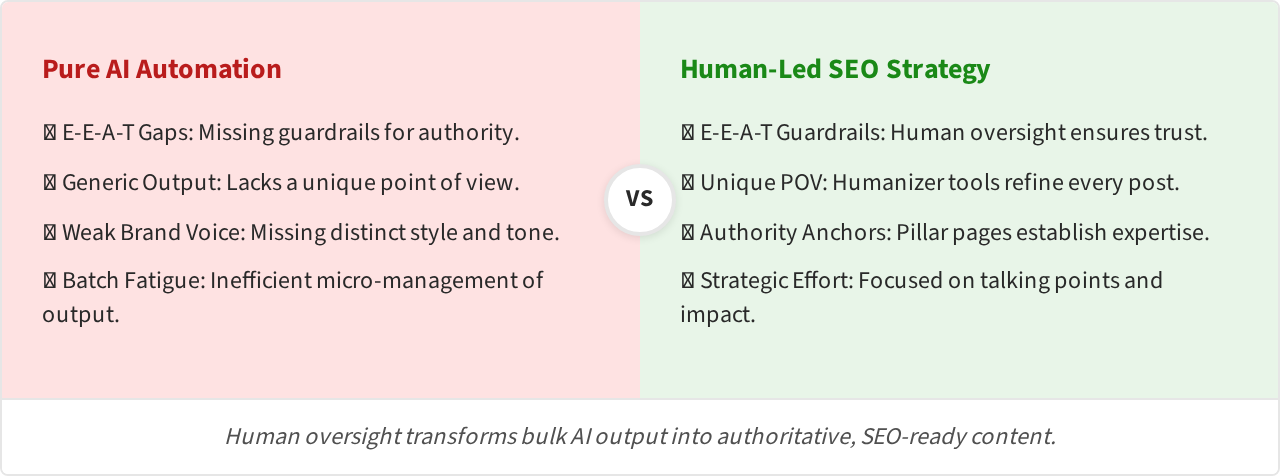
Human oversight is the essential guardrail for E-E-A-T when you replace writers with AI for many pages. A humanizer tool with unlimited rewrites helps teams refine their work.
This ensures every blog post shows a unique point of view.
Defining the Authority Anchor
The strategy centers on flagship pieces that serve as the primary source of expertise for a specific topic. To succeed with bulk article generation seo, you must build pillar pages characterized by a distinct brand voice and a refined writing style that establishes immediate credibility.
While you generate bulk content to cover broad keywords, each article within your production schedule must support these human-vetted posts to achieve a high content score.
A common humanize text example involves inserting unique expert insights into the article structure to separate your blog from generic competitors. By focusing on tone of voice within these anchors, you create a foundation where every blog post reinforces your authority and matches the intended topic perfectly.
Allocating Editorial Resources
Editorial effort is best spent providing detailed instructions and key talking points for impactful posts rather than micro-managing the entire bulk generation batch. It is not necessary to craft a perfect article every time; instead, ensure each article has a clean structure and provides clear conclusions for the reader.
Prioritize your article development by placing strategic ctas and calculating the optimal word count for flagship pieces.
Allow AI to handle the article size or number of words for supporting pages while you maintain control over the core assets. Using specific headings in the outline ensures that all structured articles maintain a clean heading structure and proper structure, even when utilizing unlimited words to expand the site footprint across diverse structured sections.
Maintaining a consistent editorial schedule for your pages ensures that the seo requirements are met and the blog remains authoritative. When you select keywords for the posts, ensure they align with the post content.
Reviewing each post ensures the writing style remains consistent.
Credibility flows downhill: high-authority flagship pieces provide the E-E-A-T halo that protects and elevates your technical programmatic pages.
Safeguarding Your Bulk Content Generation Against Core Updates

The bulk content generation landscape changed when Google targeted low-quality posts. The March 2024 update cut unoriginal search results by 40%.
To stay on the first page, you must do more than just make many pages. Every blog post must match search intent.
Use an AI optimizer that focuses on new information instead of repeating keywords.
SEO now requires main keywords and fresh insights for every query. Use web-connected tools to find trending keywords.
When you schedule a blog post, focus on NLP terms to capture long-tail traffic. Adjust keyword use so it feels natural.
This keeps content relevant and helps you add facts to every article.
To rank, you must analyze your target country and find long-tail keywords. Automation helps, but humans must keep the story cohesive across all posts.
Provide helpful material that goes beyond keywords. Never create many pages without checking if each serves a unique purpose.
Careful keyword use and real-time analysis help your assets survive updates.
- Prioritize information gain by providing unique perspectives or data not found in existing search results
- Align every article with specific user intent to satisfy the primary ranking signal for modern SEO
- Utilize real-time data connections to ensure content reflects the most current trending queries
- Implement rigorous human-in-the-loop cleaning to eliminate repetitive or low-value generation patterns
Information gain is no longer a luxury but the primary filter Google uses to separate programmatic authority from scaled content abuse.
Robust Website Design and Development for Digital Marketing Agencies
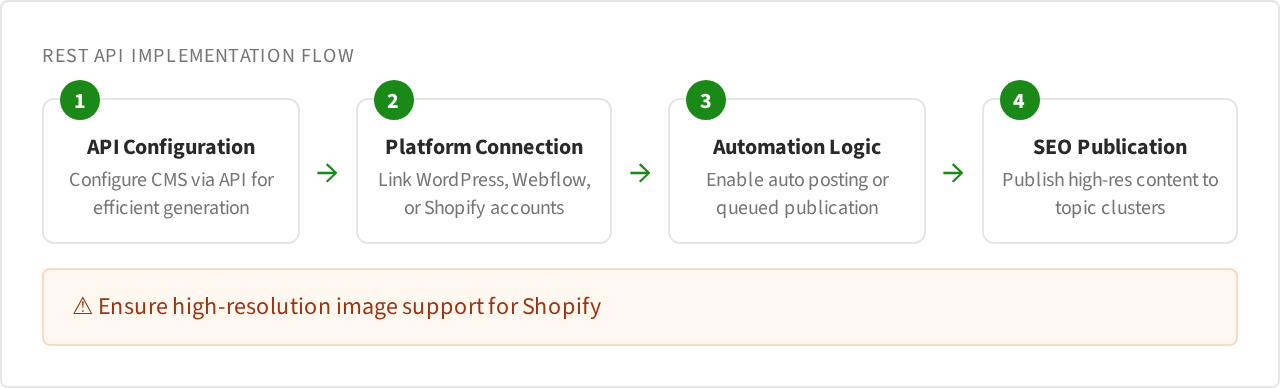
Agencies should connect AI tools to their websites to turn raw data into published assets faster.
REST API Configuration
Building a professional wordpress website requires robust cms integrations to generate blog posts efficiently through the auto posting feature. By configuring cms via api, developers can publish to wordpress automatically while ensuring that images directly to shopify remain high-resolution and properly categorized.
Whether you operate on wordpress, webflow, ghost or need a specialized shopify, webflow, ghost configuration, these connections are vital for a connected website. Whether your stack involves a custom ai shopify + woocommerce build or a standard cms, the logic remains consistent for scaling.
You should turn on auto posting to enable immediate publication or publish instantly depending on your specific output strategy. This technical foundation allows agencies to use a seo writing shopify app for seamless publishing to shopify, ensuring every blog post aligns with strategic keywords and topic clusters.
Using modern content management systems, you can queue posts to publish to maintain a steady flow of content across all pages without manual intervention.
Managing Server Load
Mass bulk injection for bulk seo generation can frequently crash a standard wordpress website if the server cannot handle the sudden rest api overhead. To prevent database locks in your wordpress site, practitioners should implement auto scheduling and batch scheduling to distribute the generation load across specific dates and times.
Instead of opting for immediate publication, use batch scheduling, topic clustering to schedule them over weeks, which protects the server while simulating organic growth patterns.
This staggered approach to automatic article publication ensures that autoposting to wordpress website environments remains stable even when pushing hundreds of pages. By selecting to publish or schedule into a staging area, you can verify each article before it goes live, utilizing scheduled posting to maintain the integrity of your professional blog and overall post architecture.
Platforms built for shopify or using a shopify integration benefit from this cautious approach to maintain speed. Use target keywords to cluster posts and schedule them to avoid overlapping resource demands.
The Fast Track to Auditing Bulk Article Generation Quality
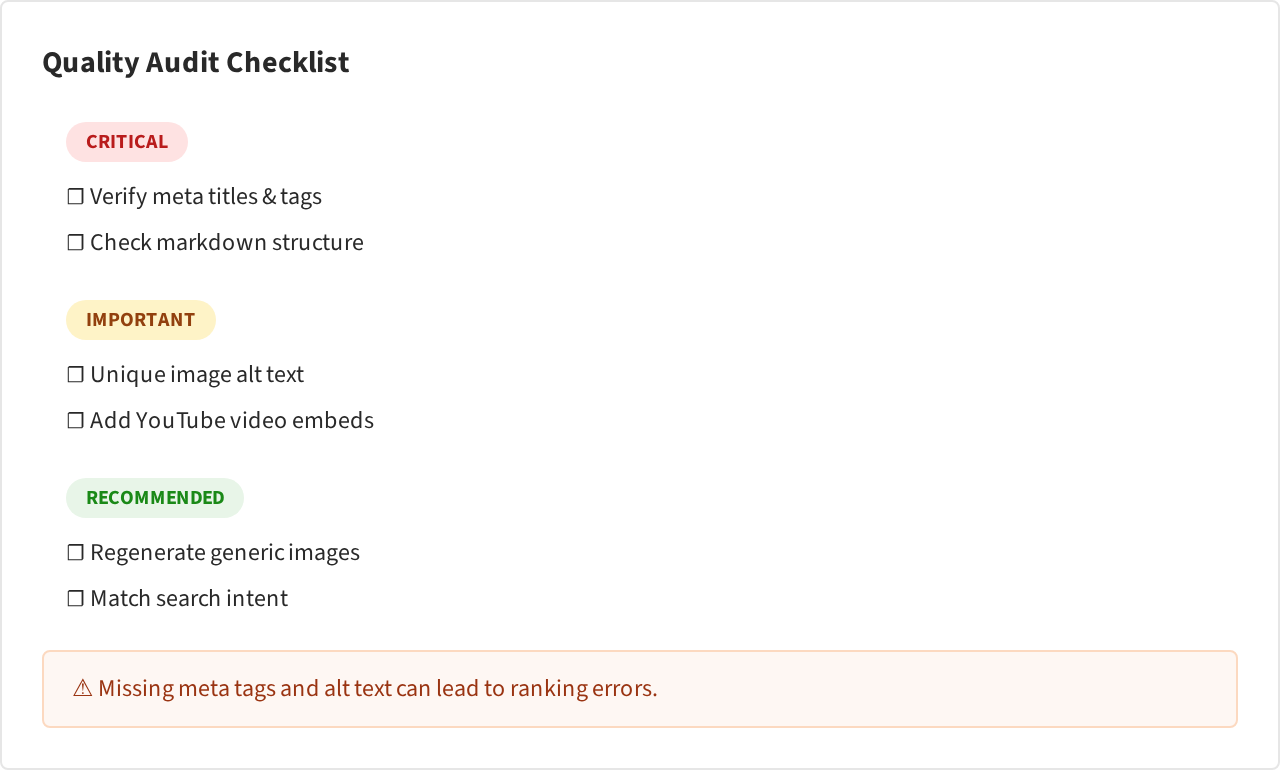
Auditing many pages requires checking meta tags that automation might miss. Use a tool to verify every meta title and description.
Ensure the generation process did not create errors and that topics stay focused. Metadata must be consistent.
Titles and descriptions should align with keywords so each blog post ranks. Check that every image has unique alt text.
Auditing means checking that you generate relevant images and every blog post includes markdown tags. Use a featured image gallery to update settings if AI images look generic.
Ensure your titles, headings, and meta descriptions reflect core keywords. For better image SEO, check that meta alt and accessibility text are correct.
Use image regeneration to create high-quality images that fit the topic. Adding YouTube videos provides the authority that posts bulk lack.
When you generate images, check that meta tags and alt text provide context. Your titles must always match the search intent of your audience.
- Verify the meta title and meta description for every post.
- Check that you generate relevant images with descriptive alt text.
- Review the titles, descriptions, outlines for logical flow.
- Confirm that alt tags and meta alt for images are present.
- Ensure all pages follow clean on page seo protocols before you schedule them.
- Check that your titles, headings, meta descriptions are consistent.
How Silo Architectures Prevent Systemic Ranking Failures
Successful bulk content generation needs a framework where internal links build topical authority. Without a map for keyword clusters, your content may stop ranking.
Search engines must be able to tell your main pillar pages from supporting pages.
Siloed Linking Strategy
To generate a stronger topical network, an ai auto internal system must enforce a vertical structure where supporting posts link upward to a specific pillar article. This programmatic seo topic clusters method ensures that each blog post and every amazon affiliate article contributes to a keyword driven library rather than causing cannibalization.
By adding amazon product list data to product pages and product reviews, you can bulk generate buying guides that funnel seo traffic toward high-value conversion points.
This deliberate network planning ensures that when you bulk generate timely posts or news articles, they provide more organic traffic by strengthening the central topic of the silo. Establishing this clear hierarchy allows search engines to crawl your site more efficiently, ensuring that authority flows from small niche pieces toward the most competitive pages in your organization.
Preventing PageRank Dilution
Automated seo generation often fails when circular linking loops dilute the ranking power of product roundup articles and product roundups. Instead of a flat architecture, an effective internal linking strategy ensures internal links connect pages while using external linking to establish credibility with outgoing references.
When you schedule your content on a fixed schedule, the system must confirm that the keywords in a blog post do not compete with another blog post in the same batch to maintain a healthy amazon affiliate website.
Utilizing bulk blog posts within this siloed structure allows for more indexed entry points and more traffic, ensuring the keywords used across different pages maintain high relevance for the same topic. By preventing infinite link loops, you preserve the structural integrity of the domain and ensure that PageRank is concentrated where it matters most for your ranking goals.
Better ROI by Adding Amazon Product List and Tracking
Business owners must evaluate the labor needed for every blog post in a bulk workflow. To reduce content costs, lean teams should focus on refining the bulk content generation process.
This ensures editing does not slow down automation. To scale organic traffic, many businesses generate content in bulk to stay competitive across many keywords.
Every blog post must serve its topic well. Success depends on managing how many pages you create versus how many actually index.
A bulk content generator can produce 1,000 articles in hours. However, conversion rates often depend on adding product lists manually.
One session of article generation can yield 250 SEO articles if the strategy fits the topic. Faster publishing creates more client output while keeping a schedule for every blog post.
Effective bulk blog post generation must track which blog posts earn revenue. This helps lean teams scale organic traffic and lower costs.
A high frequency schedule helps a business owner rank well. Even when producing many posts, tracking revenue allows for better bulk article strategies.
Use a generate bulk article approach to dominate a topic quickly.
- Monitor the ratio between initial generation costs and the labor required for human-in-the-loop editing.
- Prioritize indexing as a primary success metric for bulk content to ensure visibility.
- Integrate high-intent affiliate links like an amazon product list to drive immediate conversion rates.
- Utilize tracking pixels to identify which bulk articles are contributing to business revenue.
- Maintain a high frequency schedule to dominate topical clusters across hundreds of pages.
Bulk SEO Financial Modeling Comparison
| ROI Component | Traditional SEO Production | Bulk SEO Strategy |
|---|---|---|
| Content Creation Cost | High per individual unit | Significantly lower per unit |
| Labor for Editing | Included in initial writing | Critical separate variable |
| Publishing Velocity | Low and manual | High and automated |
| Revenue Potential | Linear growth per post | Compound growth at scale |
Conclusion
The first 50 articles set your site's reputation. To run bulk article generation effectively, define your goals and apply SEO basics to every blog post. When you create drafts, focus on publishing the right pages. Start with complete SEO pages before you run bulk article generation or use bulk mode.
Use bulk mode to upload keywords while following your core settings. Create ready-to-publish posts with one click, but optimize them for your keywords. When batch generating guides or affiliate content, choose the right type and language. Publish complete SEO pages consistently and stay on a blog schedule.
Frequently Asked Questions
Will using bulk article generation SEO lead to a Google manual penalty?
While high frequency publishing can trigger red flags, Google’s March 2024 update specifically targets unoriginal content that lacks helpfulness rather than the use of artificial intelligence itself. By implementing a human-in-the-loop strategy, you ensure each article provides information gain rather than just repeating target keywords. This editorial layer helps maintain a natural keyword frequency and ensures the final blog post portfolio meets search engine optimization standards, protecting your organic footprint from being flagged as low-quality automation.
How does a human-in-the-loop approach improve the ROI of mass content?
A human-in-the-loop system reduces content costs by focusing your team's energy on refining the high-potential pages that anchor your topical authority. Instead of spending hours writing from scratch, an seo expert or marketing business owner uses ai services to generate a high volume of drafts and then audits the meta title, headings, and internal link logic. This balanced workflow allows you to scale organic traffic and increase publishing velocity without sacrificing the high-quality article standards that drive actual conversion rates.
Can bulk generation tools handle specific local data for city landing pages?
Achieving success with local landing pages requires integrating custom data points and real time serp analysis into the generation process. To avoid repetitive narratives, the human editor must verify that long tail keywords and local landmarks are correctly placed within the markdown tags of each post. By using an seo image optimizer and checking the meta description for specific geographic relevance, a digital marketing agency can produce hundreds of unique pages that feel tailored to each target country or city rather than appearing as generic templates.
What are the essential technical features for an agency bulk workflow?
Robust bulk article generation seo requires tools with API connectivity for direct CMS integration, allowing for a seamless schedule across platforms like WordPress or Shopify. Essential features include an ai seo optimizer that auto analyzes serp competitors, featured images gallery management for unique alt text, and the ability to reveal keywords reflecting current trending queries. These technical capabilities ensure that when you schedule a new blog post in bulk mode, the individual posts maintain technical seo integrity with correct meta tags and meta fields.
How do I ensure E-E-A-T when producing content at such a high frequency?
Establishing topical authority at scale requires a combination of programmatic seo libraries and expert human oversight to inject unique insights that ai engines might miss. You should focus on generating nlp keywords that capture the nuance of a specific topic while manually adding facts or case studies that demonstrate real-world experience. Verifying the meta title, alt text for accessibility, and the overall coherence of the narrative ensures that every single article serves as a trustworthy organic entry point that satisfies both users and search engine crawlers.