Modern marketing teams must balance content creation with quality to avoid helpful content system penalties. Traditional SEO results in robotic pages that create significant pain points for agencies.
Google’s March 2024 core update resulted in a 45% reduction in unhelpful content. This outcome proves that automated content production must prioritize quality over high volume.
Your production pipeline should use automation to ensure every piece aligns with SEO strategy.
AI content at scale is saturating search volume as Gartner predicts a 25% drop by 2026. Search patterns are shifting as AI chatbots take over traditional engine functions.
Smart teams use automated workflows to scale results and maintain a competitive advantage over programmatic seo. You can build a small army of assets using automated content and targeted keywords.
Traditional 'dump and publish' automation is a liability; a Sovereign Engine is the strategic path forward.
Key Takeaways
- Integrate custom brand guidelines into automated workflows to ensure every piece maintains high quality standards.
- Leverage subject matter experts for data collection to build authority and satisfy current search quality requirements.
- Deploy multi-agent systems using LLM judges to provide automated fact-checking and ensure originality assurance.
- Establish automated refresh pipelines to identify content gaps and prevent traffic decay across static published pages.
- Construct a sovereign content engine by prioritizing high-potential keywords for measurable business results.
Why Your Brand Needs a Sovereign Content Engine
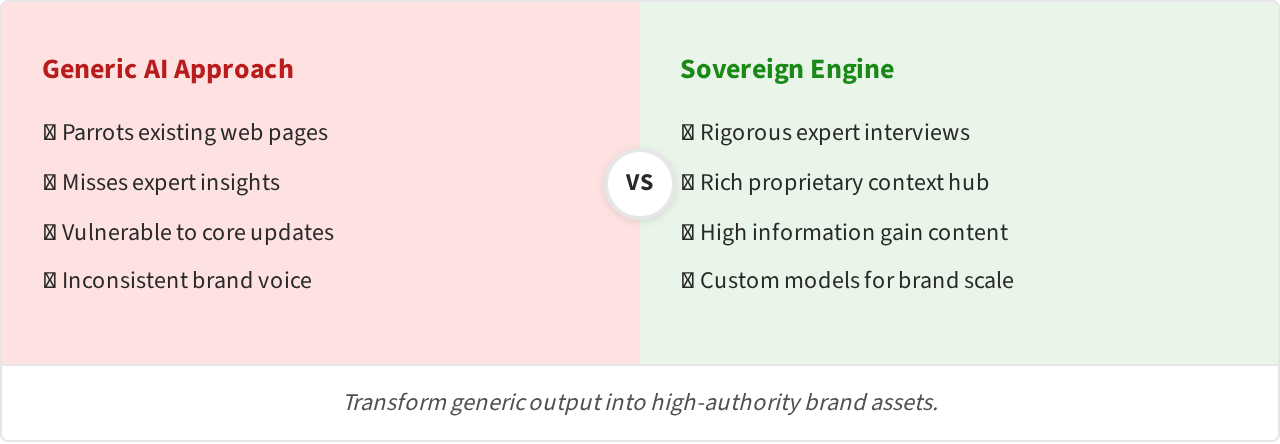
Building a content infrastructure requires moving beyond generic AI writers that parrot existing pages. To improve SEO, brands must collect data through rigorous interviews with subject matter experts.
This strategy helps your pipeline survive core updates by focusing on information quality and knowledge gaps. Custom AI models help produce content that matches your brand and meets market demand.
A sovereign workflow uses expert insights to surface reliable information that generic tools often miss. This creation pipeline relies on a rich context hub of proprietary information and research papers.
Custom AI tools analyze search intent and competitors while keeping your brand voice consistent at scale. By conducting original research, you create unique pages that provide the necessary information gain.
A workflow builds authority signals across keywords for better search ranking. Production cycles use demographic data to meet user intent.
This framework turns keywords into assets using proprietary data and AI models. Your infrastructure uses expert data to keep AI writers accurate.
- Centralize data collection from internal subject matter experts to fuel the engine
- Utilize custom ai models to maintain a brand voice consistent across all pages
- Leverage custom gpts for deep search intent analysis and competitor analysis
- Integrate research papers and original research to ensure high information quality
Proprietary data injection is the only sustainable shield against the generic AI penalty in modern search ecosystems.
Building Modular Content Pipelines with n8n and APIs
Building a repeatable pipeline requires automation-first workflows that treat each stage as a modular component.
The Modular Stack
By leveraging api access to various cloud ai providers, teams can build individual workflows that remove production bottlenecks and maintain technical health across thousands of pages. This ops stack allows for more control than monolithic SaaS, ensuring that every published outcome meets quality standards through custom automation strategies, n8n integration, and specialized seo workflows.
Successful automated seo content production depends on selecting the right article generator for each specific seo outcome. A deep n8n integration allows technical seo specialists to use conditional statements to route tasks: employ Claude for high-quality writing on complex pages, while using GPT-4 to generate metadata or analyze keywords.
Using this content pipeline approach ensures your scale is sustainable by decoupling the article downloader and archive.org scraper functions from the core generative content workflow.
The modular stack (n8n + LLM APIs + CMS) offers 10x more flexibility than monolithic SaaS tools.
The Financial Case for Building Custom Stacks
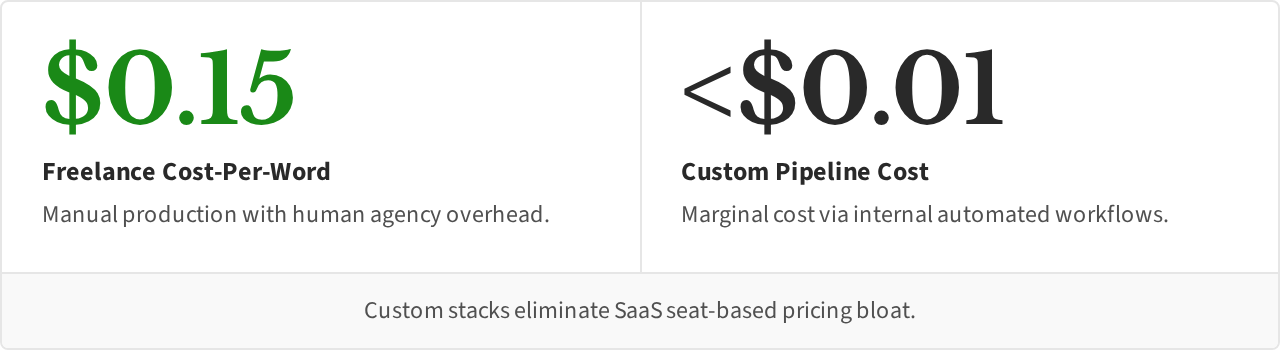
Leaders must choose between existing platforms or a proprietary pipeline for long-term value. This choice defines the value of digital assets and marketing revenue.
The ROI Model: Compare cost-per-word across freelance, premium SaaS, and custom pipelines
Implementing an automated workflow allows performance marketers and brand marketers to move beyond the high scaling costs associated with traditional agencies. While manual writing remains essential for high value activities, using an automated pipeline for landing pages helps business owners bypass the operational overhead of human-only production.
Content marketers often find that custom workflows assist in reducing operational complexity by removing the seat-based pricing typical of saas growth teams, allowing them to generate revenue through passive income generators like affiliate blogs without recurring subscription bloat. This production workflow ensures that content stays consistent across all distribution channels while protecting profit margins.
Professional associations and affiliate marketers frequently weigh decision making factors such as cpc analysis and business idea validation before choosing a specific marketing tactic. When product marketers and field marketers want to scale personalization, they rely on a robust content pipeline to keep pages published across various keywords.
By generating outlines internally, comms marketers and content marketers can control the outcome of their seo strategy while focusing on metrics that matter. This sovereign approach helps published content maintain its quality across all pages while ensuring the automated production process remains a cost-effective engine for growth.
Choosing to scale with a custom seo setup ensures a predictable outcome for every set of keywords targeted without relying on third-party pricing tiers.
Implementing Automated Quality Control with LLM Judges
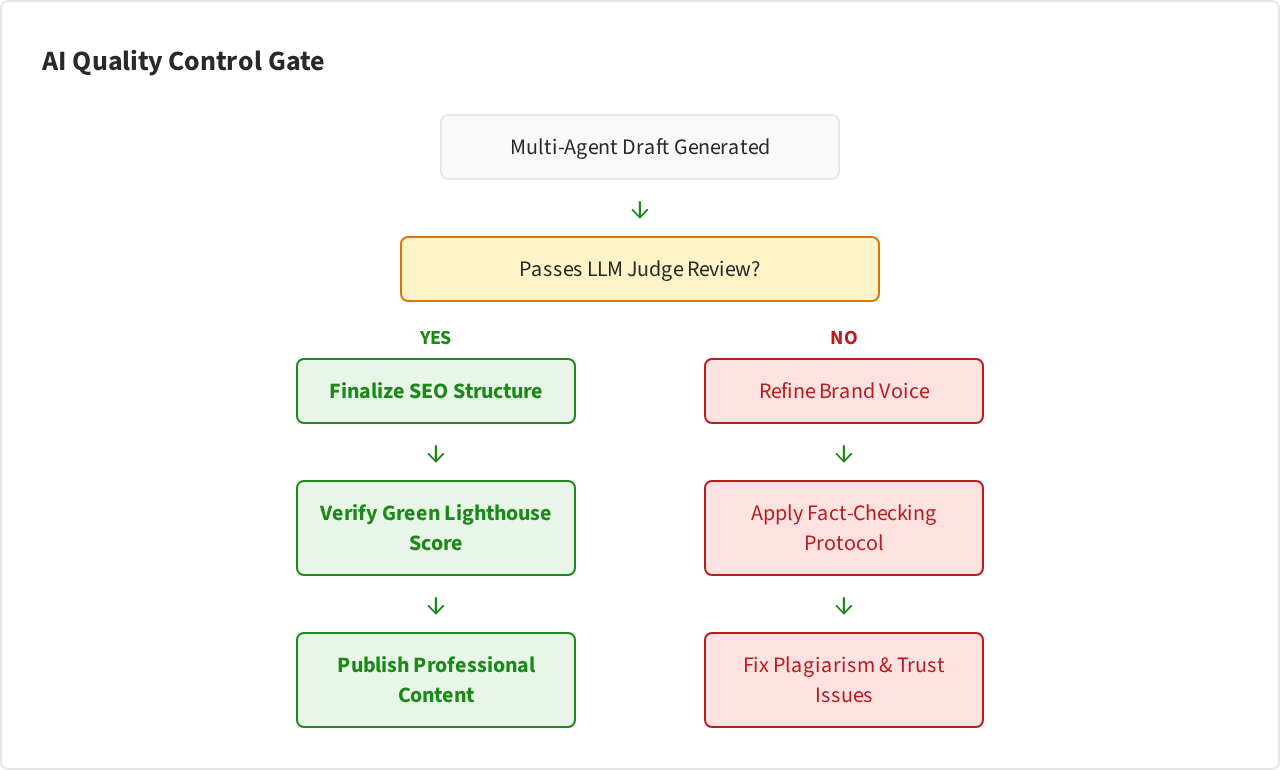
Few marketers have documented strategies for AI governance, which causes issues when they try to scale. To maintain quality standards, use multi-agent workflows that effectively simulate the human editing phase.
This pipeline checks draft pages against fact-checking protocols to ensure high quality articles are published. These workflows ensure pieces achieve a green lighthouse score and provide helpful information to readers.
A writing pipeline needs strict control through brand voice refinement and emotional analysis to ensure reliable results. During analysis, editors scan for plagiarism and missing trust elements like author bylines.
Operating at this scale allows for the rapid creation of product descriptions and FAQ sections. These incorporate original case studies and customer stories.
Training protocols ensure every SEO workflow produces professional content through human enhancement.
Workflows identify featured snippets and place keywords into the SEO structure. This automated process keeps consistency and protects your brand voice.
Adding fact-checking and plagiarism tools ensures high-quality articles and growth. Each piece strengthens your brand voice and connects with readers.
- Multi-agent workflows simulate human-in-the-loop editing at scale
- Automated fact checking protocols ensure the accuracy of product details and author information
- Brand voice refinement filters maintain content consistency across thousands of pages
- Plagiarism detection tools integrated into the production pipeline protect originality assurance
- Training protocol development allows the system to identify featured snippet opportunities automatically
Solving the Discovery Challenge for Programmatic SEO Sites
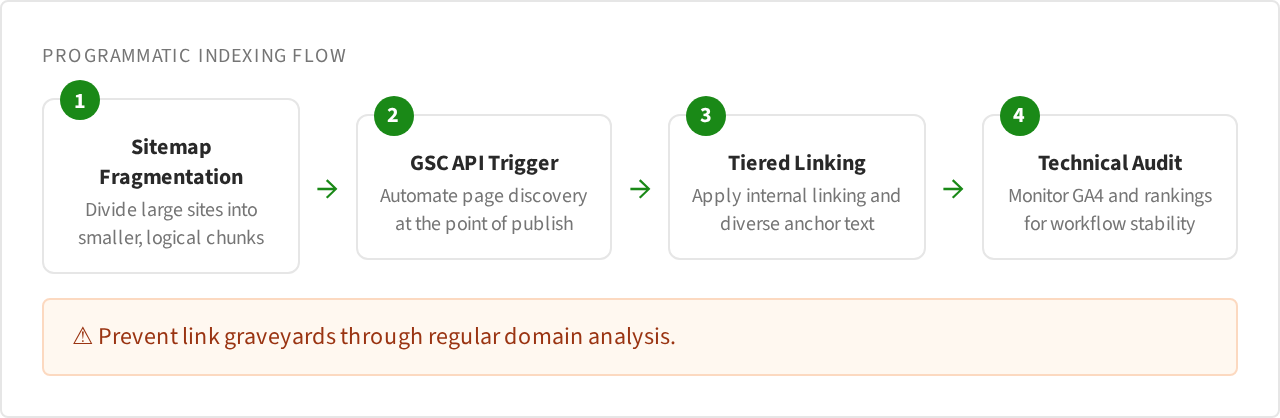
Building a high-scale SEO content pipeline often leads to a Google problem where thousands of pages remain invisible. Without a workflow to manage how you generate assets, your website risks stagnant traffic from orphan clusters that hinder the pipeline's outcome.
Indexing Triggers: Explain sitemap fragmentation and GSC API usage for automated sites
To overcome the indexing wall, sophisticated internal linking strategies must be integrated into your production workflows to ensure search results reflect your latest content. Large-scale automated writing projects, such as generating thousands of city pages or local pages for local seo, require you to submit a sitemap that is fragmented into smaller, logical chunks.
This site structure management prevents the creation of link graveyards and ensures that the technical health of your scale operation is maintained through automated seo audits and regular domain analysis. Conducting technical audits is essential for any pipeline aiming to improve search rankings and site traffic while monitoring internal linking strategies for efficacy.
Success in the google serp depends on using the Google Search Console API to trigger discovery as each landing page is published from your pipeline. By using a tiered workflow, link builders can implement a backlinking strategy and link building that uses anchor text diversified across tier content to boost domain authority.
Monitoring ranking keywords through google analytics 4 allows you to adjust your workflow based on competition levels and optimize web performance. Effective automated writing ensures your seo outcome avoids the pitfalls of spam policies or aggressive spam fighting efforts.
Effective site structure management and domain analysis ensure your search results remain stable in the google serp even as you generate new assets. When you submit a sitemap regularly after technical audits, your automated production of keywords stays visible in the search rankings to ensure a positive seo outcome while your backlinking strategy remains vital.
Discovery Methods for Automated Content
| Method | Discovery Speed | Scalability Factor |
|---|---|---|
| Standard XML Sitemap | Slow/Passive | Limited by crawl budget |
| GSC Indexing API | Near Instant | High (200 URLs/day per project) |
| Sitemap Fragmentation | Medium | Optimized for batch discovery |
| Tiered Internal Linking | Variable | Essential for orphan cluster prevention |
Preventing Traffic Decay with Automated Refresh Workflows
Effective SEO production is a cycle where a content engine must evolve with search trends. Generative pages often stay static and decay quickly, requiring a predictive strategy to maintain ranking stability.
A content pipeline for refreshing helps marketers identify gaps and optimization opportunities that manual audits miss. This loop uses social listening to forecast topics and improve blog posts through a dynamic strategy.
Automated workflows for the content lifecycle often provide a better ROI than expanding production to new keywords. High-performing systems use performance analysis to trigger updates like keyword integration or adding media.
When using programmatic seo, a content pipeline must generate fresh writing at scale to maintain relevance. This workflow ensures outcomes align with keyword targeting and engagement goals.
Performance data keeps the final outcome competitive against search trends.
- Monitor search trends to update static facts and maintain relevance in published pages.
- Utilize performance analysis to prioritize content refreshing for high-value pages over new production.
- Automate the addition of youtube videos and relevant images to improve engagement optimization metrics.
- Execute keyword integration based on real-time content gap analysis to capture emerging optimization opportunities.
Achieving Accuracy with Programmatic Fact-Verification
Reliable SEO production requires a pipeline that prioritizes information quality across every scale of the operation.
Maintenance Triggers
Effective production involves using extraction agents to scrape sources like research papers and original news reporting to verify initial drafts before they are published. These workflows allow the system to gather numbers and expert insights from subject matter experts, ensuring knowledge gap closure that often occurs in competitor content.
When the bulk article rewriter produces text for target keywords, the pipeline extracts key entities and compares them to the source CSV to ensure factual accuracy is maintained at scale. If the writing fails to connect with news references or propagates misinformation, the system assigns a score to the outcome.
This triggers the auto-deletion of pages or outreach posts that fall below a set threshold, protecting the published seo portfolio from penalties. Unlike manual research for technical guides or detailed guides, this automated process handles web 2.0s and outreach articles spun for various keywords with surgical precision.
By integrating citation frameworks into the writing process, the generate phase produces self paced guides that provide new research without the risk of hallucinations. The workflow helps to generate high-quality results and ensures that the management of pages remains professional through these verification workflows.
Conclusion
Shift SEO production to content operations. During the pilot, focus on keywords that answer customer questions using AI. Using programmatic seo automation builds authority and ensures measurable results.
Scaling requires team preparation to remove bottlenecks in the production pipeline. Use customer surveys and case studies to boost landing page conversions. Strategists monitor leads from automated workflows to ensure quality. AI integration allows for broader topics and faster results without losing content integrity.
Frequently Asked Questions
Can automated content production trigger Google penalties for my website?
Automated content production itself is not a violation of search guidelines as long as the primary goal is to provide helpful information to users. Google's March 2024 core update specifically targeted low-quality, unhelpful content that exists solely for search engine rankings. To avoid a helpful content system penalty, your production pipeline must focus on satisfying user intent and closing knowledge gaps rather than just increasing content volume. By integrating original research and proprietary information into your writing workflow, you ensure each published piece aligns with search quality standards and maintains long-term ranking stability.
How can businesses maintain high E-E-A-T standards using AI generated content?
Maintaining high authority signals requires moving beyond generic AI outputs and establishing a sovereign content engine. This involves sourcing data through rigorous data collection from subject matter experts and credentialed professionals to ensure technical accuracy. Implementing a multi-agent workflow where an LLM judge evaluates the draft against your brand guidelines and brand voice helps maintain consistency. By surfacing reliable information and including detailed author profiles with accurate author bylines, you satisfy the expert insights required for strong quality scores in sensitive niches.
What are the primary differences between programmatic seo and generative ai workflows?
While both strategies leverage automation, programmatic seo focuses on creating thousands of pages based on structured data sets, whereas generative AI workflows use language models to create narrative, informational content. A sophisticated content production infrastructure often combines both to bridge the data-to-text gap. By using a rich context hub and custom GPTs for search intent analysis, marketers can enrich data-heavy pages with helpful descriptions and customer stories. This modular approach ensures that every published article provides the information gain necessary to outrank competitors who rely on thin, repetitive templates.
Is a custom content production infrastructure more cost effective than using standard AI writers?
For many agencies and enterprises, building a custom stack using tools like n8n and direct APIs often provides a superior return on investment compared to expensive monthly SaaS subscriptions. A custom writing pipeline allows for better brand alignment and the integration of your own proprietary research papers and case studies. This architecture provides the flexibility to perform deep competitor analysis and keyword research at scale without being locked into a single tool's limitations. Over the long term, these efficiency gains transform your content operations into a defensible asset that provides a significant competitive advantage.
How does an automated refresh pipeline prevent traffic decay over time?
Static pages published from generative sources often experience ranking loss as search trends shift and competitors update their information. An automated refresh workflow uses performance analysis and web research integration to identify content gaps and optimization opportunities in existing assets. By establishing a predictive content strategy, you can systematically update published pages with fresh keywords, relevant images, and new insights. This continuous improvement loop manages the entire content lifecycle, ensuring your high quality articles remain competitive and relevant long after their initial publication.