Modern marketing faces a crisis as AI-driven content risks failing search quality standards. Gartner predicts a 25% drop in search volume by 2026.
This shift threatens organic visibility for legacy sites. To prevent seo performance loss, professionals must focus on precise optimization and rigorous content scoring.
Every stage of content operations should use comprehensive scoring to track seo performance. This data-driven approach merges content and marketing to drive success through keyword tracking.
Maintaining high scores requires regular competitor reviews and optimization. However, you must prioritize utility to ensure long-term success in the evolving search landscape.
Scaling without a quality floor is a liability, not an asset.
Key Takeaways
- Implement comprehensive content scoring to maintain high quality standards while scaling your production efforts.
- Integrate proprietary business data into your language models to prevent thin copy and hallucinations.
- Use cosine similarity and vector embeddings to ensure generated text matches your brand topic.
- Build agentic SEO workflows using enterprise cloud infrastructure instead of relying on simple plugins.
- Transition from traditional freelance teams to automated systems to achieve high volume organic growth.
The Hybrid Framework for Long-Term SEO Performance
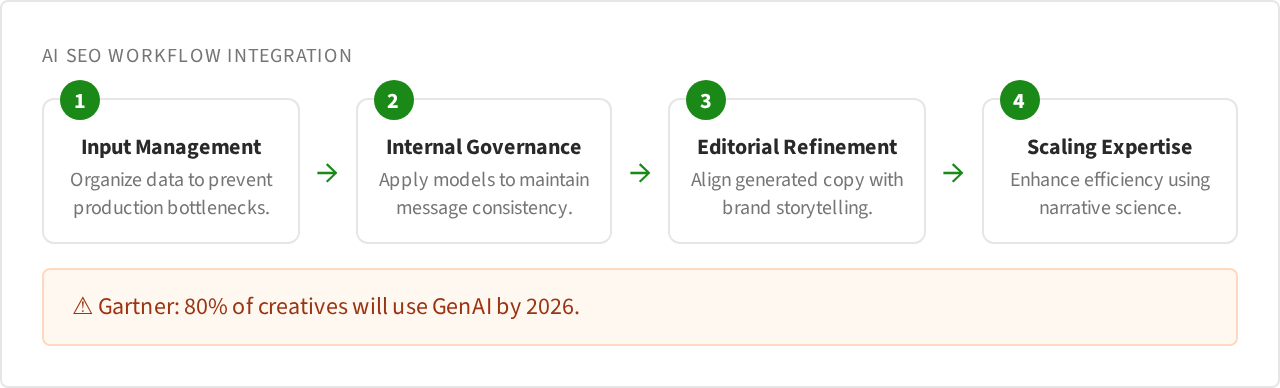
A hybrid model is essential for content strategies that scale production without sacrificing quality. This setup relies on deep workflow integration.
It allows the editorial team to oversee production through a series of automated steps.
Workflow Integration
Integrating a language model into existing cycles requires operational rigor to prevent production bottlenecks by managing data inputs effectively. According to Gartner, 80% of creative professionals are expected to use generative AI in their daily workflows by 2026.
Brand marketers must design smarter workflows that allow the head of content and the content team to maintain message consistency across all channels. By using a series of repeatable workflows, the director of content can implement internal governance models that refine how the model generates copy.
This streamlined workflow ensures that every generated sequence of words aligns with the overarching brand storytelling goals. When using a language model correctly, the operational workflow enhances editorial efficiency by allowing the content team to access content structures that support complex narrative science and scaling expertise.
Quality Floor Pillars
To ensure every word of generated content provides value, the editor in chief must establish strict editorial standards and a business relevance statement. The hybrid model functions best when the generative process is governed by specific parameters that define the brand voice.
During the training phase, content marketers should focus on the sequence of logic to improve the understanding of the topic. Each word must be brand infused to ensure the quality copy reflects the core values of the organization.
By setting these parameters for the gpt model, the editorial team maintains a high quality floor for all content through a rigorous audit. This focus on content structures allows for a robust social media strategy and multimedia brand storytelling that remains consistent.
Ultimately, understanding how the gpt model processes words involves rigorous training to ensure the output meets the highest expectations.
The Edit-to-Write Ratio Flip ensures quality remains high as volume increases by shifting human focus from drafting to refining.
Grounding AI in Truth – Using Proprietary Data
Using internal documents creates a context hub that prevents the language model from hallucinating. Large language model training data often comes from sources like the Internet Archive.
To improve results, teams should clean text using python routines or scikit learn. Using vector embeddings generates article embeddings that align with your specific topics.
Relevance engineering at scale involves calculating cosine similarity between generated text and transcripts. Writers use this framework to ensure words match brand topic centroids.
This method uses mxbai embed large to capture unique insights. When training language models, you define the semantic space where the model operates.
Calculating similarity ensures every word follows brand guidelines.
Large language model output depends on the training language models receive. Use article embeddings and cosine similarity to verify that copy reflects your internal data.
This relevance engineering process helps the language model understand complex subjects. We calculate similarity scores to compare generative output against proprietary training sets.
These steps ensure every word adds unique value.
- Use internal transcripts to create a rich context hub for retrieval-augmented generation.
- Map content to specific business relevance centroids to avoid generic advice from public datasets.
- Implement vector crunching to maintain data privacy while scaling your high-volume output.
- Utilize scikit learn for calculating cosine similarity against your verified topic centroid.
Proprietary data is the only sustainable moat against the ocean of generic AI content currently saturating the search results.
Adding Human Experience to Defeat Generic Content
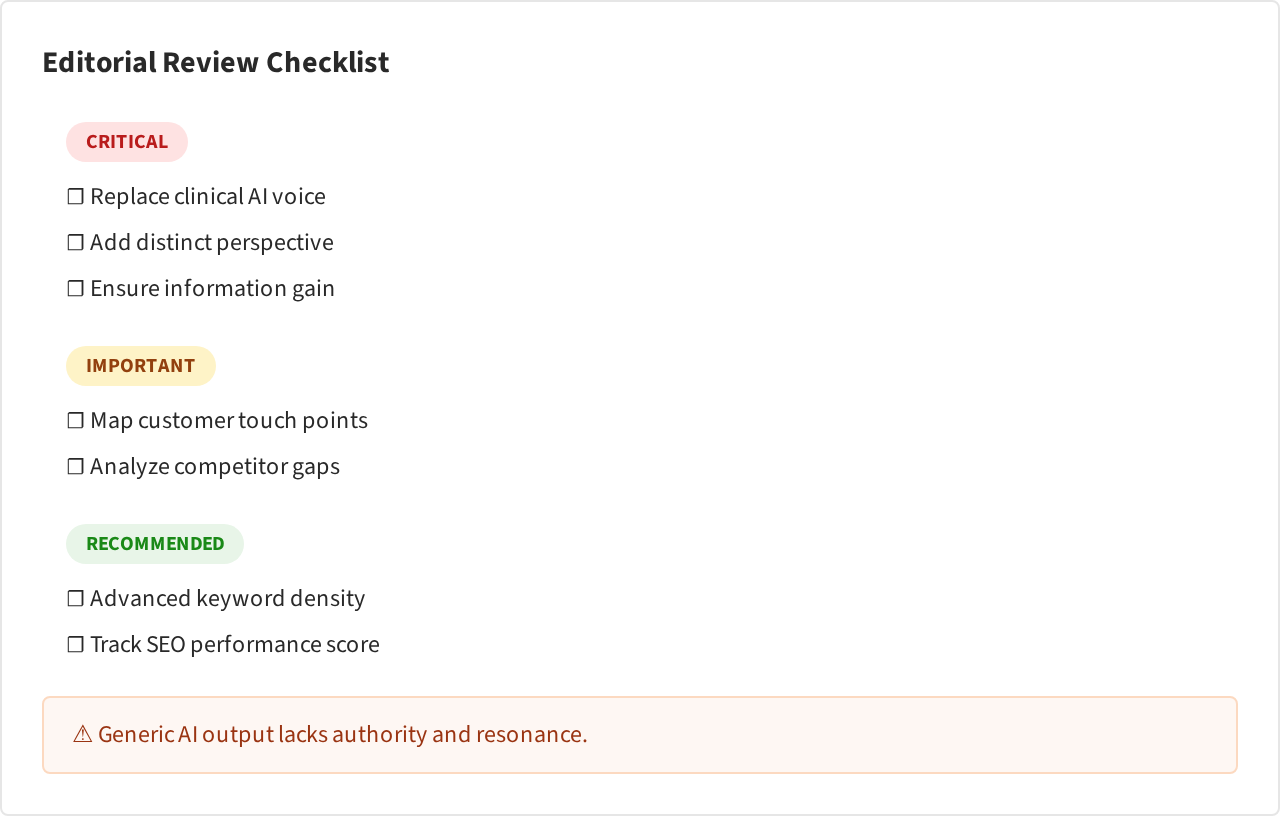
Brands must focus on content resonance and information gain to avoid a clinical voice. Prioritize these factors during content refresh efforts.
Focus on human stories rather than repeating what competitors say. This approach makes your content more engaging and unique.
Human-Only Value Markers
Incorporating human stories and real customer touch points is a vital step to ensure your seo content achieves a high comprehensive scoring level. While natural language processing is excellent for content brief generation or creating competitor outlines, it often relies on gut feel patterns and n grams that lack content utility.
By collaborating with field marketers and product marketers, you can inject new research and key innovations into every piece of seo content. This process acts as a robust detection system against fake authors and aids in detecting generated content, allowing for pioneering undetectable articles that move beyond the clinical voice.
By using the CRAFT SOP, you can analyze competitors and replace generic linguistic forms with customer focused content that improves your seo performance score. This method ensures that every article provides unique value that cannot be replicated by basic algorithms, shifting the focus from quantity to high-impact information gain.
When you analyze competitors, look for gaps where proprietary data or internal perspectives can be used to ground the narrative in reality.
Editorial Review Checklist
A structured editorial review is the final step to track content and maintain a high seo performance score. This comprehensive scoring approach helps teams track content during content refresh efforts and ensures that every update helps refresh existing content effectively.
During this review, senior editors should analyze competitors to find key takeaways that a standard research paper or competitor analysis might miss. By focusing on customer focused content and specific customer touch points, you can avoid the subjectivity quagmire of generic AI output that lacks a distinct perspective.
Use advanced optimization and specific keywords to ensure your performance score beats top performing competitors. This comprehensive optimization strategy allows you to track and improve your seo performance by focusing on information gain rather than gut feel.
Finally, ensure your keywords and scoring reflect the true content resonance required for modern search engines to recognize your authority and expertise. This final polish ensures that the clinical voice is replaced with an authoritative tone that speaks directly to the reader's needs.
Information Gain vs. Commodity Content
| Feature | Commodity AI Output | Information-Gain-Led Content |
|---|---|---|
| Data Source | Public web scraping | Proprietary research and field insights |
| Narrative Style | Clinical voice and n grams | Human stories and customer touch points |
| SEO Outcome | High risk of penalty | Strong comprehensive scoring and performance |
| Search Intent | Surface level keywords | Key innovations and unique takeaways |
Connecting the Pipes – Stack Integration Strategies
Technical leads should replace fragmented tools with enterprise cloud infrastructure. An agentic partner provides the flexibility needed for high-volume production.
Explore why a fine-tuned model integrated into your workflow outperforms simple tools. Marketers can integrate with jasper iq to maintain knowledge while using generative ai.
This use of jasper iq ensures every asset aligns with your strategy while protecting data.
Custom API pipelines let engineers manage JSON objects and HTML directly to avoid repetitive AI patterns. Agentic workflows automate keyword research and build customer stories.
This scales production without sacrificing LLM ethics or relying on basic autocomplete features. NLG tools in custom dashboards automate categorization for long-term SEO success.
Request a demo to learn how Jasper moves beyond generic machine learning models. To learn about implementation, use transformer technology to scale brand stories with Jasper’s oversight.
- Deploy custom api pipelines to maintain maximum security and flexibility for brand assets.
- Utilize agentic seo workflows to automate keyword clustering and competitive analysis.
- Shift from isolated plugins to enterprise cloud infrastructure to eliminate manual data entry.
- Adopt an llm agnostic architecture to prevent platform lock-in and future-proof your stack.
Maintenance Protocols – Monitoring for AI Content Decay
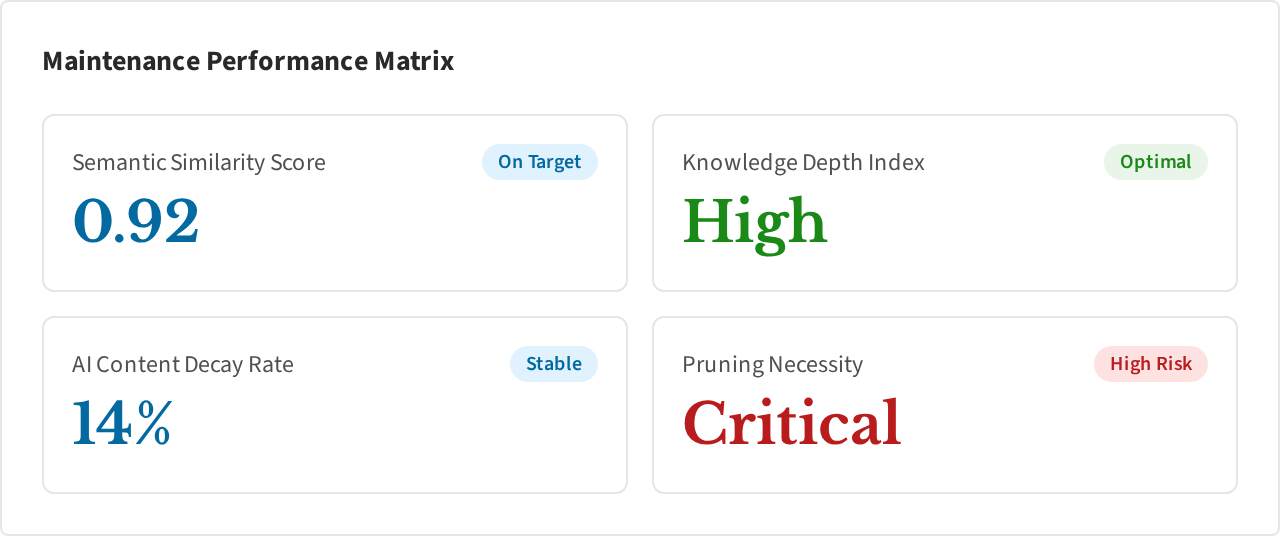
Growth operators should monitor visibility loss to protect organic search across keyword portfolios and topic clusters. While scaling marketing, you must also learn how to maintain healthy rank reports for your digital assets.
Indexing Health Workflow
Monitoring your google search console is essential to identify technical ghosting which occurs when AI content lacks unique semantic signals required for indexing speed and crawling budget. You should explore your rank report to detect keywords that are failing to rank higher on search despite high word counts or optimal lengths.
Using jasper for content will help your marketing by improving user signals and click-through rates while managing canonical tags.
When you watch your gsc clicks and core web vitals, you can detect optimization opportunities and perform mapping keywords to ensure your stories reach the right audience. A demo of jasper iq can show you how to identify negative ai searches and maintain seo performance for your brand stories while providing the knowledge needed for growth.
Effective seo strategies require a deep knowledge of your niche to achieve success.
Maintenance Performance Matrix
A structured matrix allows you to rank higher on search by implementing structural updates and refreshing last updated dates to improve content performance and organic visibility. You should explore content pruning with embeddings to remove assets that lack knowledge depth or have low similarity scores in semantic search environments like ai overviews.
Tools like jasper ensure your success by aligning with search intent and entity optimization.
Use a demo of jasper iq to facilitate smarter pruning and internal linking while you take a quick glance at backlinks and metadata for keyword improvements. By following seo best practices for your customer, you can turn ai search visitors into a success story for your seo team and learn from every success to ensure continued visibility and traffic.
Constant auditing ensures you learn how your strategy evolves over time.
The Hard Data Behind High Volume ROI
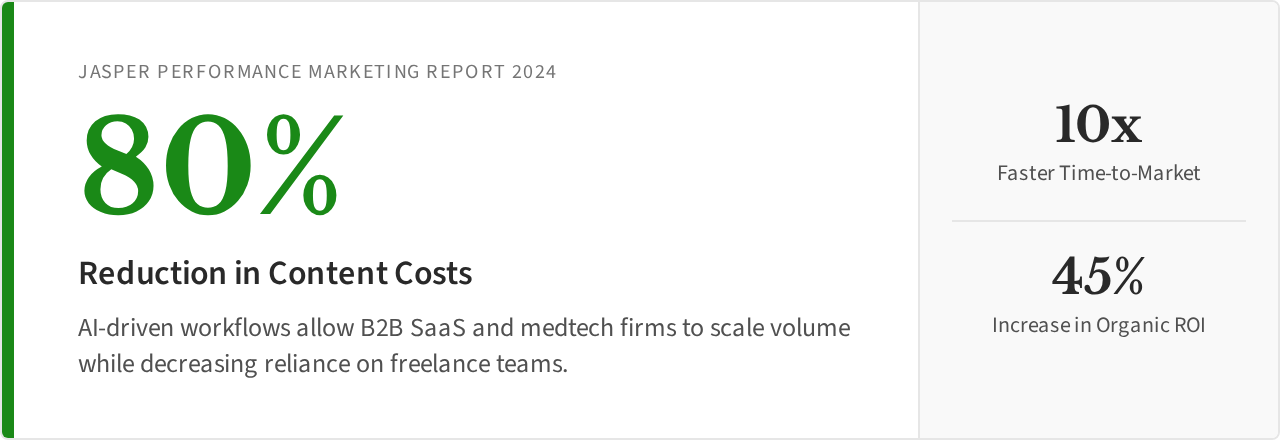
Operations leaders often find freelance teams costly and slow. Scaling content improves profitability, especially for B2B SaaS or medtech firms using automated workflows.
Chief revenue officers must monitor asset performance to ensure quality. Intelligent systems reduce manual labor costs and boost efficiency for digital health companies.
Jasper lets customers enter new markets without massive overhead. Success requires understanding how SEO works in a competitive landscape.
You should learn how these tools accelerate execution to meet funding goals. A demo shows how jasper iq speeds up time-to-market for news and finance sites.
Performance marketers align business relevance with user intent to generate leads. Data analysis helps lower staff turnover and optimize media budgets.
Use a demo of jasper iq to maintain brand voice. To succeed, you must learn that performance depends on quantitative benchmarks.
Leaders should analyze click-through rates to prove ROI. SEO drives business outcomes without increasing freelance costs.
Use customer insights to refine stories for better relevance. B2B SaaS providers can use Jasper to scale and meet growth metrics.
- Identify the inflection point where automated production costs fall below traditional human-only drafting.
- Transition internal teams from primary creators to high-level editors to maximize output volume.
- Align production schedules with real-time performance data to eliminate waste in the content lifecycle.
- Utilize agentic workflows to handle research and grounding, reducing the time spent on manual fact-checking.
Conclusion
Start your strategy with a pilot targeting your customer profile and positioning. Use agentic workflows to build a pillar page and blog post following best practices. Use comprehensive scoring to track content and keywords to ensure seo performance outpaces competitors. This framework helps track seo performance so seo content hits strategic goals. Use comprehensive scoring to ensure keywords rank well while refining your profile.
Use video transcripts to create blog posts for your target market. Apply decision frameworks to community engagement and organic growth. Track content through social media or ads so scoring reflects seo performance. After publishing, check consolidation opportunities to beat competitors. Consistent seo content reaches your market with blog posts and a pillar page for strategic goals.
Frequently Asked Questions
Does Google penalize content solely because it was generated by an AI?
Google does not inherently penalize content simply because it was created using artificial intelligence. Their algorithms are designed to prioritize the utility and quality of the information provided to the user rather than the method of production. To avoid a drop in organic visibility, professionals must ensure that their content meets the standards of the Helpful Content Update by offering unique insights and demonstrating clear expertise.
To maintain search performance, it is vital to move beyond the echo chamber of generic AI generation. Successful strategies involve defining a strategic focus and using rigorous content scoring to verify that the output provides more value than existing competitors on the search engine results page. High quality standards remain the primary factor in long term SEO success.
How can technical teams ensure that AI generated content remains factually accurate?
Factual accuracy is best maintained by grounding the large language model in proprietary data and internal documents rather than relying solely on the model's pre-existing training data. By using a context hub and performing data wrangling with python cleaning routines, teams can prevent the language model from hallucinating or producing thin, irrelevant copy that fails to meet business standards.
To further refine accuracy, engineers can calculate cosine similarity between the generated text and verified brand transcripts. This process of relevance engineering ensures the sequence of words aligns with the brand’s specific topic centroids. Using vector embeddings allows for a mathematical verification of the text, ensuring every word follows strict brand guidelines and adds genuine value for the reader.
What is the role of relevance engineering in maintaining high quality search rankings?
Relevance engineering at scale is essential for preventing semantic drift, which occurs when generated content gradually loses its alignment with the intended topic. By using article embeddings and calculating similarity scores, writers can ensure the generative output remains within the desired topic centroid. This technical approach allows for the creation of a mega embedding that captures a series of unique insights tailored to a specific audience.
By utilizing a relevance engineering framework, organizations can represent meaning through vector embeddings and verify that the generated words reflect their internal training data. This ensures the language model achieves a deep understanding of complex subjects, which is necessary to defeat generic content and maintain authority in an evolving search landscape dominated by generative answers.
Why should an enterprise prioritize an agentic workflow over simple content production tools?
An agentic workflow provides the flexibility and complexity needed for high volume production by chaining multiple agents together to manage tasks like keyword research and customer story building. Unlike basic plugins or content spinners that may trigger manual reviews, agentic partners integrate directly with core api endpoints and enterprise cloud infrastructure to provide more sophisticated machine learning outputs.
This approach allows the engineering team to manage json objects and html tags directly, avoiding the repetitive patterns typical of stochastic parrots. By building on an llm agnostic architecture, brand marketers can maintain customer knowledge while utilizing generative ai. This integration ensures that every asset aligns with the broader marketing strategy while protecting proprietary data and improving efficiency.
How do you measure the return on investment for large scale AI content operations?
Measuring ROI involves analyzing the actual performance of every asset to ensure it meets strict quality standards and drives desired business outcomes. Operations leaders should evaluate the shift from high labor costs associated with traditional freelance teams to the efficiency gains of automated workflows. Key metrics include the click through rate, lead generation volume, and the overall impact on the headline metric of profitability.
Successful organizations use comprehensive scoring to track seo performance against competitors in real time. By analyzing performance data, companies can lower turnover rates for internal staff while optimizing earned media budgets. This quantitative approach allows a chief revenue officer to see how intelligent systems accelerate execution and ensure that business results match long term strategic goals.